


If you walk into a boardroom and say, "We need to invest in SimReady assets," half the room will tune out. The other half will assume you're talking about a science project for the R&D team.
The name implies it’s only for simulation – it is not. "SimReady" refers to a technology specification from NVIDIA that solves a massive Enterprise crisis. This crisis isn't about simulation; it's about Silos.
The "Forklift Duplicates" Problem
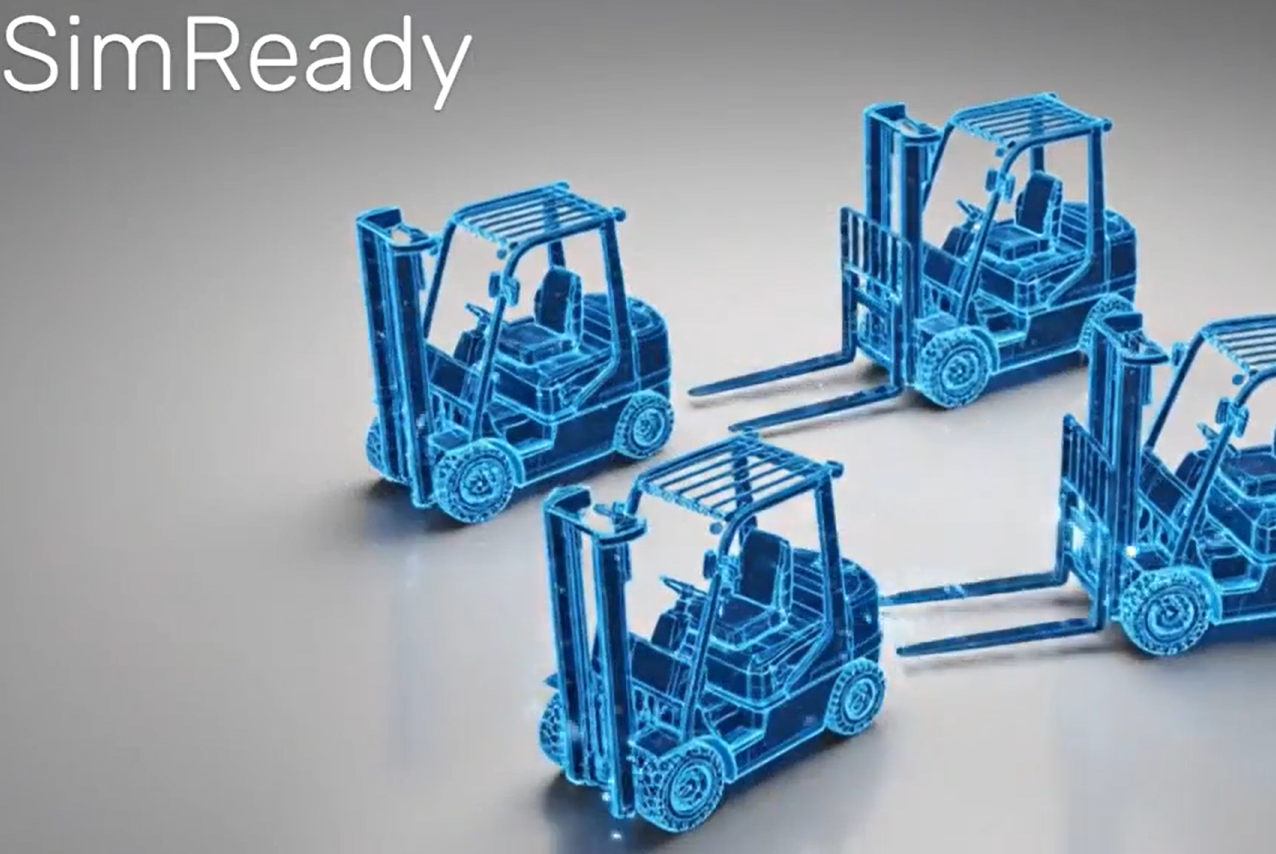
Right now, your organization is likely building the exact same asset—let’s say, a “Forklift” 3-4 different times, in 4 or more different tools, for multiple departments.
- The Engineering Forklift (CAD/STEP): The Goal: Manufacturing precision. The Reality: It’s a 1.2GB file. It has every nut and bolt, but it has no textures. It freezes your laptop when you’re trying to open it (For 20+ min). You can't run it in real-time; it’s accurate but unusable for most applications.
- The Marketing Forklift (FBX/GLB/SketchFab): The Goal: It needs to look sexy in a render or on a trade show screen. The Reality: It’s a hollow shell. The dimensions are "eyeballed." It looks great, but if you tried to run a physics simulation on it, the tires wouldn't grip the floor. It’s a pretty lie.
- The Simulation Forklift (URDF/Collision Mesh): The Goal: Crash testing and path planning. The Reality: It’s an ugly collection of hit-boxes. It looks like Minecraft blocks, but it knows what "mass" and "friction" are.
- The AI Training Forklift (Synthetic Data): The Goal: Teaching a robot to recognize a forklift. The Reality: This team needs "Semantic Labels." They need the asset to shout "I am a Forklift!" to a computer vision system. They often rebuild the asset again just to add these tags.
The result? You are paying 4x the cost for zero interoperability. You have four "sources of truth," which means you have none.
NVIDIA’s SimReady specification is the solution to this mess, but the name is hiding the value.
A SimReady asset is not just an asset ready for simulation. It is a Unified Intelligent Asset. It is built on Pixar’s Universal Scene Description (OpenUSD), and it acts as a container that holds everything everyone needs:
- For Marketing: It holds high-fidelity PBR materials and textures (It’s beautiful).
- For Engineering: It holds accurate metadata and dimensions (It’s true).
- For Simulation: It holds rigid-body physics, mass, and friction data (It behaves).
- For AI: It holds semantic labels and sensor data (It speaks).
This is the "Holy Grail" of 3D data. You build it once.
- The Marketer drags it into Blender for Keynote backdrop.
- The Engineer drops it into Omniverse to test clearance.
- The Data Scientist uses it to generate 10,000 synthetic images to train a computer vision model.
The AI Revolution
This isn't theoretical. Companies like Lightwheel and Serve Robotics are using these assets to bridge the "Sim-to-Real" gap.
They aren't just simulating physics; they are generating Synthetic Data. By using assets that already "know" what they are (thanks to semantic labeling), they can train robots in a virtual warehouse before the physical building even exists.
If your asset is just a "dumb" 3D model, you can't do this. You’re locked out of the AI workflow.
The Verdict
We need to stop thinking of this as "Simulation." We need to start thinking of it as Intelligence.
If you are a leader in this space, Demand Intelligent Assets. Demand assets that carry their own physics, data, and logic.
Whether you call it "SimReady," "Enterprise-Ready," or "The Single Source of Truth," the mandate is the same: Stop building the same forklift four times.
Build it once. Make it smart. And let it work for everyone.
Digital Twins encompass multiple use cases including Simulation, Marketing, Operations perhaps we should start calling our intelligent master assets “TwinReady” instead of “SimReady” just food for thought NVIDIA …
Sources & Inspiration:
- NVIDIA Technical Blog: Into the Omniverse: Open World Foundation Models Generate Synthetic Worlds for Physical AI Development
- NVIDIA Docs: The SimReady Specification & Semantic Labeling
- Smart Spatial: Operational Digital Twins
- Dell Technologies: Digital Twin Journey: Computer Vision AI Model Enhancement
Written by Arthur Alter - CRO