
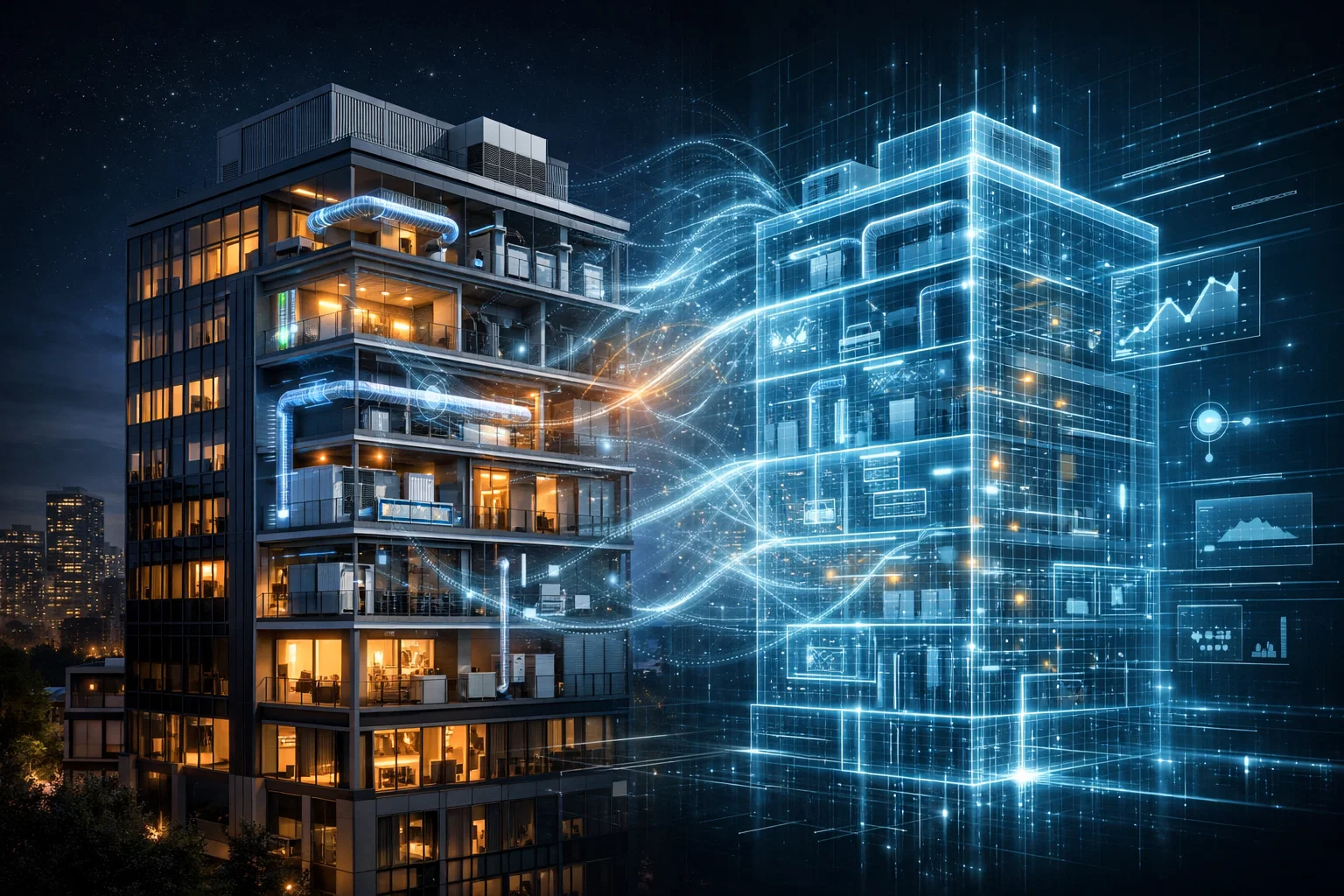


Every HVAC hum, every lighting adjustment, every spike in energy use — your building is constantly whispering about how it feels, performs, and wastes money. For decades, operations teams have had to guess what it’s saying. But digital twins finally give your building a voice — and the results are game-changing.
The Old Way: Reactive, Repetitive, and Risky
If you’ve ever managed a portfolio of buildings, you know the pain points by heart:
- “Why is this floor always too cold?”
- “Why did the chiller fail again — and why now?”
- “Why do our energy reports never match reality?”
Traditional maintenance and building systems work like rear-view mirrors — showing what already happened. You fix things after they break, spend hours chasing anomalies, and burn money on inefficiencies you can’t see.
That era’s ending.
Meet the Digital Twin — Your Building’s Live Brain
A digital twin is not just a 3D model. It’s a living replica of your building that thinks, learns, and predicts.
By connecting your IoT sensors, BMS, and data streams into one immersive environment, it lets you:
- See how every system behaves in real time.
- Simulate what happens before it happens.
- Catch small inefficiencies before they become costly repairs.
Think of it as a control room with x-ray vision — showing you where energy is leaking, comfort is falling, or performance is slipping.
AI: The Building’s New Autopilot
When you add AI into the mix, the digital twin gets smarter every day.
It learns patterns — how temperature shifts through the afternoon, how occupancy affects air quality, and where the energy spikes come from.
Instead of waiting for alarms, your system can self-adjust.
AI tweaks HVAC settings based on occupancy, opens dampers to balance CO₂ levels, and even predicts which equipment needs servicing next month — not next emergency.
It’s like giving your facility a self-driving mode (and a coffee).
From Data Overload to Insight
Operations leaders often complain that they’re drowning in dashboards but starving for insight.
That’s where AI-driven twins shine — they turn endless sensor noise into clear, actionable stories:
- “This zone is over-ventilating by 12%, here’s how to fix it.”
- “These chillers can reduce peak demand by 9% if sequenced differently.”
- “This conference wing will hit comfort limits by 3PM — adjust flow now.”
It’s decision support, not data chaos.
The Payoff: Comfort + Efficiency + Predictability
Facility directors who’ve adopted digital twins see:
- Fewer breakdowns through predictive maintenance.
- Higher occupant comfort thanks to smarter airflow and lighting.
- 15% average efficiency gains in energy use (and that’s just year one).
- Data-driven conversations with finance, sustainability, and HR — finally all on the same page.
Because when you can measure comfort and energy in the same interface, operational meetings turn from finger-pointing to optimization.
Why Smart Spatial Leads This Shift
Smart Spatial’s operational digital twin platform makes this transformation practical.
It brings all your building data — sensors, BIM, systems, and people — into one 3D environment.
For Operations, it’s a command center where teams can test scenarios, detect inefficiencies, and act faster.
For Executives, it’s a visual story of performance — showing where money is saved, sustainability goals are met, and risk is reduced.
And the best part? The twin doesn’t retire when the day ends.
It stays alive — training new staff, running simulations, and continuously improving decisions.
Your building becomes a perpetual learning system.
A Building That Works With You
If the past was about reactive maintenance, the future is about proactive intelligence.
Your next operational breakthrough won’t come from another BMS upgrade — it’ll come from a smarter way of seeing.
Digital twins make your building transparent, teachable, and more profitable.
Because when your facility finally talks, it’s not just noise — it’s strategy.
(This article draws inspiration from the study “AI-Driven Digital Twins for Enhancing Indoor Environmental Quality and Energy Efficiency in Smart Building Systems,” published in 2025. We’ve translated its academic findings into real-world insights for operations leaders.)