


Here’s a bold statement: not every “digital twin” deserves the name.
The term gets thrown around so often that it’s starting to lose its meaning — applied to everything from 3D models to entire city simulations. But a real digital twin isn’t just a pretty visualization. It’s a living, breathing virtual entity that mirrors the physical world in motion, not just in shape.
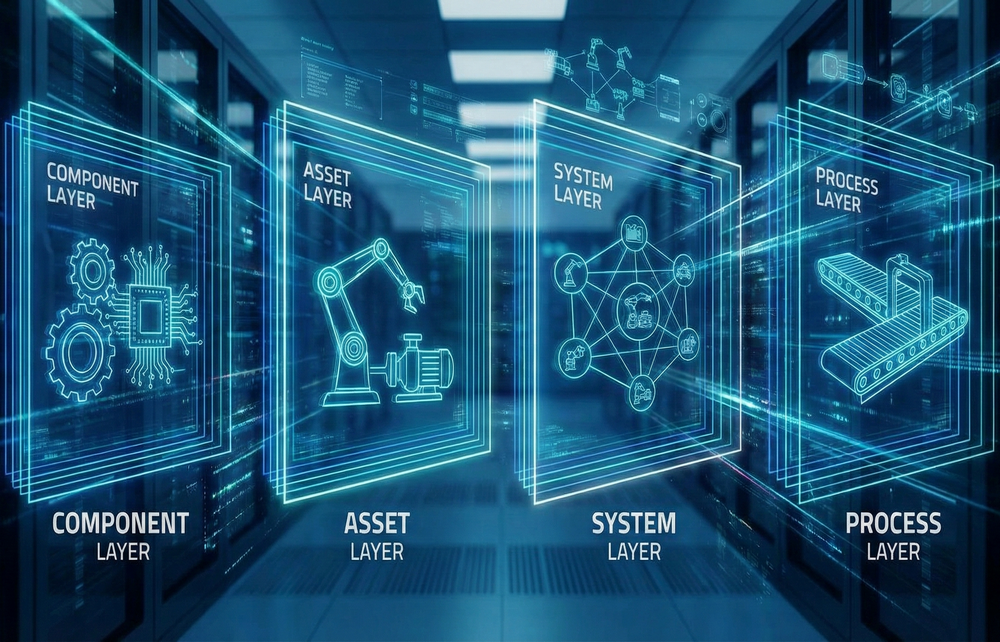
To understand what makes a true twin powerful, you need to know its anatomy. There isn’t just one type of digital twin — there are four. And each operates at a different altitude of intelligence, from the smallest component to the entire production line.
Let’s break it down.
1. Component Twins — The DNA of Performance
Every complex system is built from critical parts that take the hardest hits. A Component Twin zooms into that micro level — modeling a single high-value part that keeps the bigger system alive.
Think of a rotor blade on a wind turbine, or a turbocharger in an engine. These parts endure punishing stress and environmental extremes. With a Component Twin, engineers can track those stresses in real time, predicting failure before it happens.
It’s the foundation of predictive maintenance — and where reliability begins.
2. Asset Twins — The Machine’s Digital Mirror
Scale up one level and you get the Asset Twin: the full digital counterpart of a machine, robot, or engine. It’s where multiple Component Twins come together to reveal how the whole asset behaves.
An Asset Twin doesn’t just tell you what’s happening — it shows how every subsystem interacts. Efficiency losses, wear patterns, and energy performance become visible. The data tells a story, and that story leads directly to lower downtime and higher output.
In other words: the twin doesn’t just describe the machine — it teaches it how to run better.
3. System Twins — The Orchestra, Not the Instrument
A System Twin (sometimes called a Unit Twin) steps back and looks at the symphony, not the solo.
It connects multiple assets together to model how an entire process unit behaves as one coordinated system — a production line, an HVAC network, a microgrid. You can watch the rhythm of a manufacturing cell, see how robots interact, or detect bottlenecks forming before they slow down output.
System Twins reveal the choreography of operations — how machines, software, and humans move together.
4. Process Twins — The Enterprise in Motion
And finally, the big picture: the Process Twin.
This is the bird’s-eye view — the digital counterpart of an entire workflow or facility. From supply chain logistics to material flow, from one department to another, a Process Twin lets you see how every moving part affects the business as a whole.
This is where optimization turns into orchestration. You can balance production loads, coordinate teams, and align operations across continents. It’s the control room for your digital transformation.
Zoom In. Zoom Out. See Everything.
Each layer of a digital twin adds a different kind of intelligence.
- Component Twins reveal the heartbeat.
- Asset Twins show the muscle.
- System Twins map the coordination.
- Process Twins illuminate the strategy.
Real innovation comes when you can move seamlessly between them — from the vibration in one part to the pulse of the entire enterprise. Because in the end, downtime can start with a single bolt, and inefficiency can begin with a single blind spot.
Where Smart Spatial Comes In
This is exactly where Smart Spatial’s operational digital twin platform stands apart. Our system unites all four layers — from the micro view of a single asset to the macro dynamics of an entire operation — into one immersive, data-driven environment. Each model in Smart Spatial is alive with context: real sensor data, AI insights, and simulation feeds that bridge engineering, operations, and decision-making. You can “fly through” a data center or facility in 3D, open an asset’s x-ray view, or analyze live energy flow and system behavior — all within the same interactive interface.
In Smart Spatial, the Component, Asset, System, and Process Twins are not separate silos. They’re interconnected layers of the same digital organism — synchronized, scalable, and designed for action. Whether you’re optimizing an HVAC loop, testing an emergency response scenario, or training new operators, the platform allows you to zoom in, zoom out, and interact with every level of your operation in real time. That’s not just visualization — that’s operational intelligence made tangible.
The smartest organizations are already integrating all four. They’re not just building twins — they’re building ecosystems of insight.
The future doesn’t belong to those who digitize — it belongs to those who connect.