
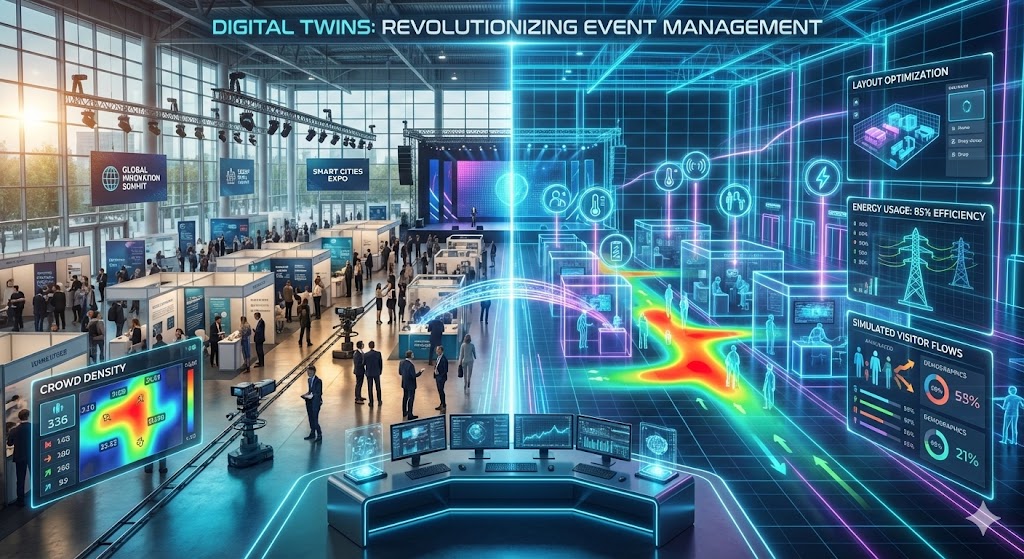


Why static floor plans are out — and twice-lived experiences are in.
Event planning has always been a balancing act — deadlines, vendors, last-minute changes, and the occasional emergency that turns a calm schedule into controlled chaos.
Despite registration apps, spreadsheets, and event software, planners still face the same challenge: unpredictable conditions and limited visibility. Static maps and floor plans can’t adapt to the living, breathing complexity of real events.
Enter digital twin event technology — a new frontier where venues can be explored, tested, and optimized before a single banner goes up.
The Digital Twin Revolution in Event Planning
Digital twins for event management transform the way organizers design and execute experiences.
They create a real-time, interactive 3D model of a venue connected to live data and IoT sensors.
Planners can walk through a virtual venue twin, experiment with different layouts, simulate visitor flow, and preview branding weeks before setup. Attendees can explore the space virtually, and sponsors can visualize their booth placement with precision.
This isn’t just virtual event planning — it’s a simulation-driven rehearsal that turns chaos into confidence.
Why Events Still Struggle (Even in the Digital Age)
A 2025 North American industry survey found that over 60% of event producers face last-minute layout changes because planning data was inaccurate or out of date. Traditional tools don’t solve spatial complexity — they just document it.
That’s where digital twins for event management stand apart. They integrate IoT data, 3D modeling, and AI simulation so organizers can identify problems long before the event begins.
The twin becomes a predictive planning assistant — finding bottlenecks, validating floor plans, and preventing costly last-minute fixes.
Beyond 3D Maps: The Living Venue
A digital twin platform goes far beyond a static 3D map. It’s a living, data-driven environment powered by sensors, AI, and automation.
- Monitor crowd movement, temperature, lighting, and equipment status in real time.
- Run simulations to test booth layouts, signage visibility, and traffic flow.
- Provide attendees with immersive virtual tours through AR/VR-based digital twins.
This level of interactivity delivers what no PDF or spreadsheet ever could — a true spatial understanding of how your event will look and perform.
Why Digital Twin Event Technology Matters
1. Data-Driven Decision-Making
Predictive analytics let teams simulate different crowd scenarios and design options, reducing risks and optimizing layouts before build-out begins.
2. Enhanced Attendee Experience
Virtual walkthroughs and digital navigation tools improve confidence and comfort. Guests arrive already familiar with the space — leading to higher engagement and satisfaction.
3. Sponsor Visibility and Measurability
Sponsors gain year-round exposure through immersive digital booths. Augmented reality signage and post-event engagement analytics provide measurable digital sponsorship ROI.
4. Operational Efficiency and Safety
Event teams can track crowd density, equipment status, and emergency procedures in real time. Digital twin monitoring helps detect issues before they escalate.
Data: The New Event Currency
In modern event management, data is the new currency — and digital twins mint it.
With digital twin data visualization, planners track foot traffic, session popularity, engagement time, and even energy consumption. These insights improve layouts, sponsorship strategies, and sustainability.
- 70% of technology leaders now prioritize digital twins in their strategy (Hexagon, 2025).
- 15% average efficiency gains in event operations (McKinsey).
- 57% report measurable sustainability improvements.
The message is clear: digital twins don’t just mirror reality — they make it measurable.
The CFO’s Perspective: ROI That Scales
For CFOs, a digital twin event management solution isn’t a luxury — it’s a business case.
- Cost Efficiency: Detect design flaws early and avoid costly rework.
- Revenue Growth: Extend brand reach through hybrid digital experiences.
- Sponsorship ROI: Offer measurable, data-backed engagement to premium partners.
Organizations using digital twins report up to 15% cost savings and new revenue streams through hybrid event monetization and remote attendee participation.
How Smart Spatial Powers the Future of Event Management
The Smart Spatial operational digital twin platform brings all these capabilities together — designed to elevate both Sales & Marketing and Operations in one immersive environment.
For Sales and Marketing, Smart Spatial turns every event into a living, interactive showcase. Companies can demonstrate complex products, host virtual booths, and guide prospects through 3D experiences that communicate value instantly. These immersive spaces extend engagement beyond the show floor, creating digital assets that continue generating leads long after the event ends.
For Operations, Smart Spatial provides real-time visibility and simulation tools that streamline execution. Planners and facility teams can test layouts, predict crowd behavior, monitor live sensor data, and optimize flow — reducing cost, downtime, and risk. The result is a connected, data-driven control center that keeps every stakeholder aligned from setup to teardown.
By uniting these perspectives, Smart Spatial transforms event management into an ecosystem of insight — where marketing impact and operational performance converge in a single, twice-lived experience.
The Twice-Lived Future of Events
We’ve entered the era of twice-lived events — experienced once in the digital twin, and again in the real world.
Sponsors reach broader audiences. Attendees explore without friction. Organizers make decisions grounded in data, not guesswork.
But the value doesn’t end when the lights go down.
Once the physical event wraps, the digital twin remains alive — an always-on environment that continues to generate leads, host virtual tours, and extend engagement for months afterward. Exhibitors can repurpose their spaces for ongoing demos, training, or hybrid follow-ups, turning what was once a three-day show into a year-round experience hub.
As the industry evolves, digital twin event technology will define the next decade of innovation — merging foresight, efficiency, and storytelling into one unified experience.
Your next event doesn’t start on setup day — and it doesn’t end at teardown. The twin of your venue is already waiting for its first virtual step.